1. Introduction
The enforcement of the so-called “Yellow Envelope Act” introduced additional considerations in determining the necessity of separating bargaining units. Specifically, Article 14-11 (4) of the Enforcement Decree of the Trade Union and Labor Relations Adjustment Act (the “Trade Union Act”) provides that, regarding a subcontractor labor union's request for collective bargaining, when the Labor Relations Commission makes a “decision on the separation of bargaining units” for the principal contractor's workplace, it must give special priority to the following factors over other considerations:
“The commonality or similarity of interests among labor unions, whether the interests of one labor union can be adequately represented by another labor union, and the likelihood of conflicts among labor unions and the risk of distortion in labor-management relations, if the existing bargaining unit is maintained”
These additional considerations apply only to collective bargaining involving principal contractors and subcontractor’s labor unions under the Yellow Envelope Act. By contrast, in disputes concerning the separation of bargaining units among labor unions representing employees of the principal company itself, the general criteria set forth in Article 14-11 (3) of the Enforcement Decree—such as significant differences in working conditions, employment status, and bargaining practices—continue to apply.
In the “Manual Win-Win Bargaining Procedures for Principal and Subcontracting Companies (p. 22), the Ministry of Employment and Labor (“MOEL”) interprets Article 14-11 (4) of the Enforcement Decree as applying to situations in which labor unions belong to different umbrella organizations and further suggests that bargaining units may be separated on that ground.
Due to this explanation by the MOEL, there was a risk of misunderstanding that, where a principal contractor is required to bargain with subcontractor labor unions under the Yellow Envelope Act, bargaining units may be separated solely on the grounds that the unions are affiliated with different umbrella organizations.
This article examines whether, under the Yellow Envelope Act, the mere fact that labor unions are affiliated with different umbrella organizations is sufficient, by itself, to justify the separation of bargaining units when a principal contractor engages in collective bargaining with subcontractors’ labor unions.
2. MOEL’s “Manual on Win-Win Bargaining Procedures for Principal and Subcontracting Companies”
(1) MOEL’s Interpretation of Article 14-11 (4) of the Enforcement Decree
The MOEL’s Manual explains that, when determining whether bargaining units should be separated with respect to subcontractor employees, the factors set out in Article 14-11 (3) of the Enforcement Decree—which establishes the general criteria for the separation of bargaining units—must continue to be taken into account. At the same time, however, the factors listed in Article 14-11 (4) are to be given priority.
According to the MOEL’s Manual, this approach is intended to ensure that decisions on the separation of bargaining units in collective bargaining involving principal contractors and subcontractor labor unions appropriately reflect the particular circumstances of each workplace.
(2) Example: Separation of Bargaining Units Based on Umbrella Organizations
The Manual also explains that bargaining units may be separated into Umbrella Labor Organization A and Umbrella Labor Organization B and suggested the below illustration as an example:
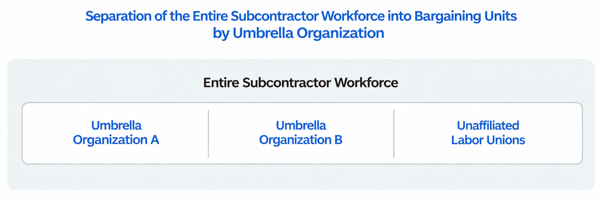
(3) Misconception that Different Umbrella Organizations Automatically Justify Separation of Bargaining Units
When the Manual was first issued, some interpreted it to mean that bargaining units could always be separated whenever labor unions were affiliated with different umbrella organizations. A closer reading of both the Enforcement Decree and the Manual, however, does not support that interpretation.
Even under the Yellow Envelope Act, the system of a single bargaining channel remains in effect, and the principle that bargaining units should be separated only as an “exception” remains unchanged. That principle continues to be reflected in decisions of both the courts and the Labor Relations Commission.
Article 14-11 (4) of the Enforcement Decree was introduced to address issues that may arise where labor unions are affiliated with different umbrella organizations. However, that does not mean that bargaining units may, as a general rule, be separated solely on that basis. In our view, where none of the specific concerns contemplated by Article 14-11 (4) is likely to arise, the mere fact that labor unions are affiliated with different umbrella organizations should not, by itself, justify the separation of bargaining units.
Accordingly, the need to separate bargaining units should be assessed based on the substance of the relevant circumstances, including whether the labor unions have materially different interests, whether one labor union can adequately represent the interests of another, and whether maintaining a single bargaining unit is likely to result in continuing inter-union conflict or distort labor-management relations. The fact that the unions are affiliated with different umbrella organizations should not, by itself, be given decisive weight.
3. Labor Relations Commission’s Decisions on Bargaining Unit Separation Following the Enforcement of the Yellow Envelope Act
(1) Cases Rejecting the Separation of Bargaining Units
The Seoul Labor Relations Commission dismissed a petition for the separation of bargaining units that was based on conflicts between Korea’s two largest national labor federations. The Commission found that differences arising from the federations’ respective histories, backgrounds, longstanding conflicts, and ideological orientations are no more than subjective and optional circumstances between those organizations and did not constitute a reasonable basis for separating bargaining units. The Commission further explained that Article 14-11 (4) of the Enforcement Decree requires priority to be given to the interests and circumstances of the labor unions involved when determining whether bargaining units should be separated; it does not mean that an individual labor union or an umbrella organization may itself constitute a separate bargaining unit.
Similarly, the Ulsan Labor Relations Commission strictly applied the statutory criteria and declined to separate the bargaining units. It found no significant differences in working conditions, employment status, or bargaining practices, and concluded that, although certain differences in interests existed among the labor unions, their common or shared interests outweighed those differences. The Commission further held that differences in bargaining approaches alone were insufficient to establish that one labor union could not adequately represent the interests of another.
(2) Cases Granting Bargaining Unit Separation
By contrast, the Gyeongbuk Labor Relations Commission held that the applicant labor union should be separated from the overall bargaining unit for subcontractor employees. The Commission noted that the applicant union had frequently been in dispute with the employer of its members and had remained in conflict with the other labor unions as it had filed a petition for corrective relief against Labor Union A alleging a breach of the duty of fair representation, as well as a criminal complaint against the chairperson of Labor Union B for unfair labor practices. The Commission further found that maintaining a single bargaining unit was likely to exacerbate inter-union conflict and distort labor-management relations.
Likewise, the Chungnam Labor Relations Commission recognized the need to separate bargaining units, taking into account that the applicant labor union had independently sought recognition of employee status against the principal company even before the Yellow Envelope Act came into effect. The Commission also found that persistent conflicts among the labor unions over matters such as the use of workplace bulletin boards and compliance with the duty of fair representation demonstrated a lack of commonality of interests among the unions and raised doubts as to whether one union could adequately represent the interests of another.
(3) Analysis of the Commission’s Decision-Making Trends Regarding the Separation of Bargaining Units
When the MOEL first published its Manual, many practitioners understood it to mean that bargaining units could be separated whenever labor unions were affiliated with different umbrella organizations. Recent Labor Relations Commission decisions, however, suggest that the criteria for separating bargaining units are being applied more rigorously than initially anticipated.
Given that the Yellow Envelope Act imposes new collective bargaining obligations on principal companies, a broad or indiscriminate approach to the separation of bargaining units could place a significant burden on employers. Against that backdrop, the current direction of the Labor Relations Commission’s decisions appears understandable.
One aspect of the recent decisions nevertheless remains open to question. The relationship between Articles 14-11 (3) and 14-11 (4) of the Enforcement Decree remains unclear.
In our view, Article 14-11 (4) merely requires the additional factors set out in that provision to be given priority over the general criteria in Article 14-11 (3); it should not be interpreted as establishing an independent set of criteria that may be applied without regard to those general criteria. If that is the case, the Labor Relations Commission should, in every case, determine whether the general criteria under Article 14-11 (3) have also been satisfied.
4. Conclusion
In collective bargaining between principal companies and subcontractor labor unions under the Yellow Envelope Act, the criteria governing the separation of bargaining units are expressly set out in the Enforcement Decree to the Trade Union Act. While Article 14-11 (4) in the Enforcement Decree requires priority to be given to the additional factors set out in that provision, the general criteria under Article 14-11 (3) must also be examined.
In our view, a decision by the Labor Relations Commission is unlikely to withstand judicial review if it relies solely on the additional factors set out in Article 14-11 (4) without first determining whether the general criteria under Article 14-11 (3) have also been satisfied.
* This article is a summary of an article published in the September issue of Monthly Labor Law.
